
Surprising discoveries (#4)
Counterintuitive new findings about mass media and public health, Republican support for science, and AI.

Prospect Park, Feb 23, 2026
Surprising discoveries
Media effects can backfire: mainstream radio programming can decrease contraception use, but public health programming can increase it. During a field experiment in Burkina Faso, women given access to local radio with standard local programming saw a 14% drop in contraception use, likely due to reinforced traditional gender norms. However, those who listened to a targeted science-based campaign — which crowded out about 17% of local debate and call-in show programming at peak listening time — saw a 16% increase in use and a 9% reduction in births. (Glennerster, Murray, and Pouliquen / NBER)
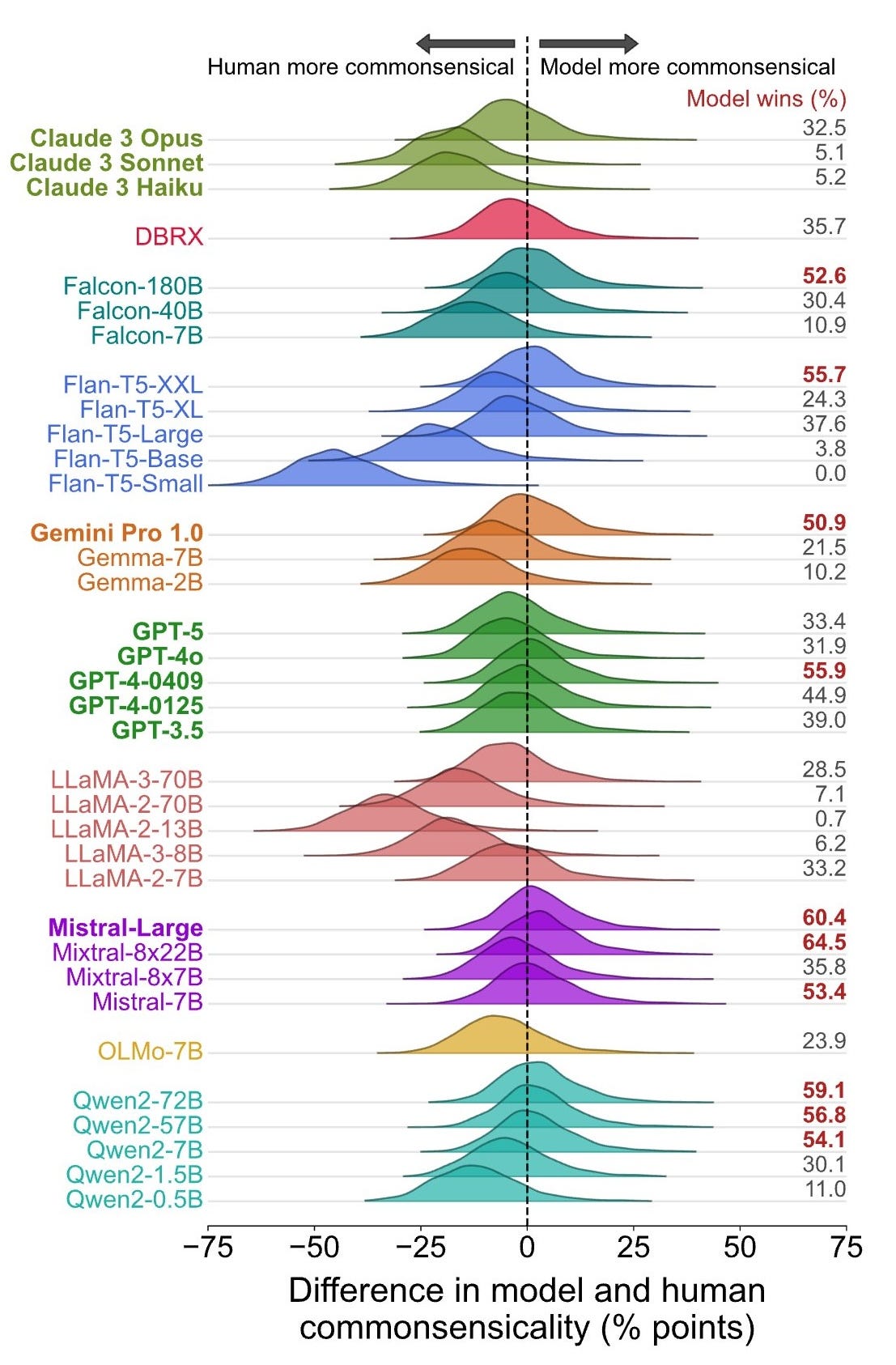
There is tremendous variation in what humans consider “common sense”. LLMs, by comparison, often occupy a modest position. While AI benchmarks often rely on ‘objective’ ground truths, a new paper considers the usage of ‘common sense’ evaluation — agreeing with statements like “80% of success is showing up” or “an accountant is good at math”. There is vast variation among humans in agreement with such statements and LLMs struggle to resemble humans. Interestingly, some older and smaller models prove to be more competitive. (Nguyen, Watts, and Whiting / PNAS Nexus)
Not just content: algorithmic feeds shift users toward more conservative positions and the effect is "sticky." In a field experiment, switching from a chronological to an algorithmic feed on X (Twitter) for seven weeks moved users to the right on issues like policy priorities and the war in Ukraine. Notably, the effect didn't reverse when the algorithm was turned off. (Gauthier, Hodler, Widmer and Zhuravskaya / Nature)
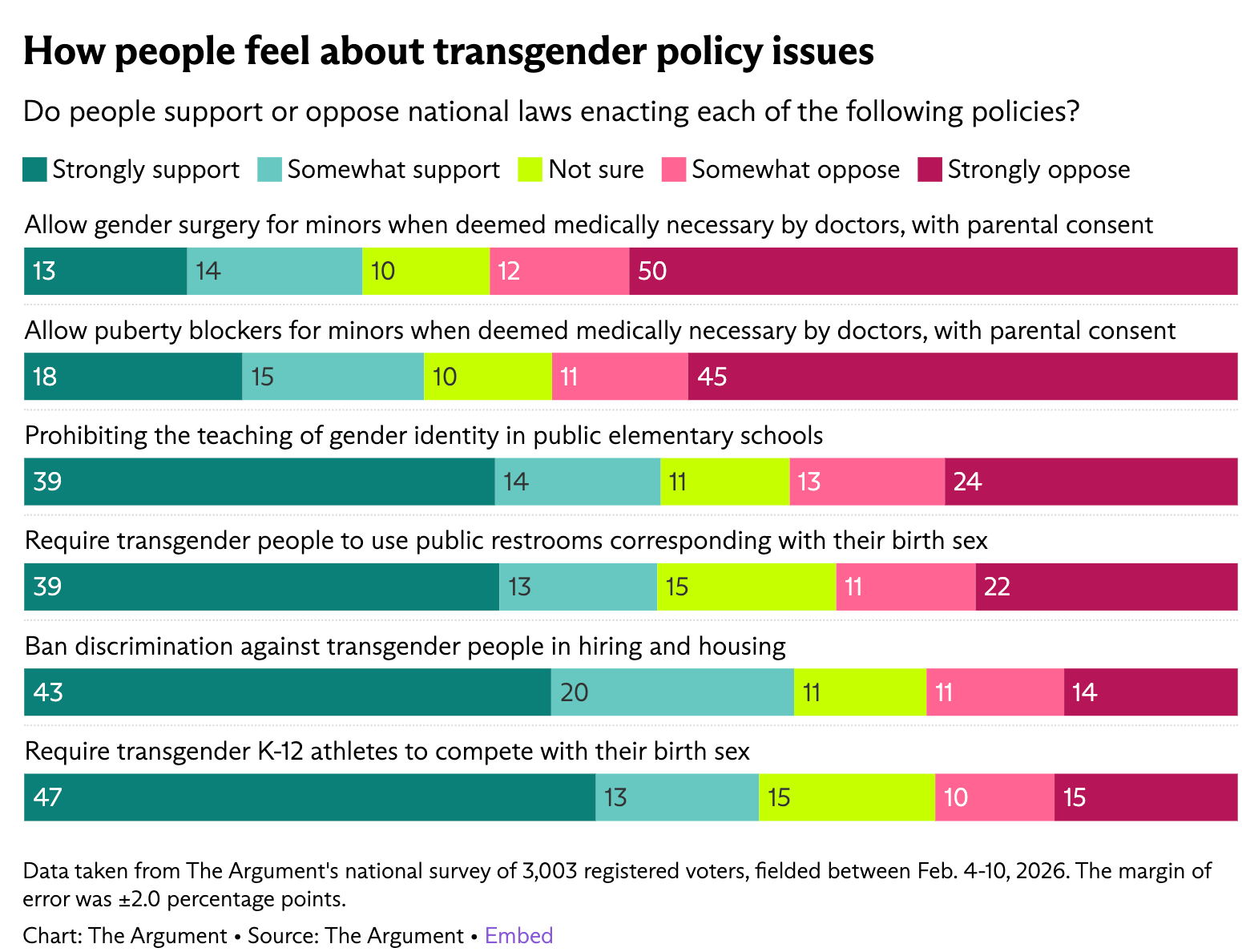
Public support for trans rights has seen a notable decline in recent years and specific opinions are mixed. Voters have flipped on issues like bathroom access and are increasingly opposed to allowing parents of trans children to make medical decisions in consultation with doctors. (Jerusalem Demsas / The Argument)
Americans are spending a smaller share of their income on food than ever before. As the United States has grown wealthier, the total portion of the average budget dedicated to food has steadily declined. This trend is likely driven by rising earnings and a massive increase in spending on other lifestyle categories. (Derek Thompson / Stefan Schubart / Mike Konczal / Consumer Expenditure Survey)
One in four American adults provides unpaid care for someone with a chronic need. More than 63 million people — roughly 25% of the adult population — provide unpaid support for others due to age, illness, or disability. (NORC / Caregiving in the US)
Norway’s $2 trillion sovereign wealth fund saw a 20% productivity boost using AI. The fund utilized Claude to build a financial analysis tool that automated over 213,000 work hours of market monitoring. This success coincides with a broader push in the Nordics, with Sweden also announcing a new initiative to develop large-scale sovereign AI models. (Anthropic / Vladimir Salnikov / Trung Phan)
Most Americans do not support the construction of new data centers built in their area, but those who do are willing to pay a premium. Despite the high energy demands of AI infrastructure, in a new poll 52% of “data center supporters” (who are a minority) are willing to pay an extra $10 in their monthly utility bill to support the construction of a new data center in their area. (Politico / The Tipping Point)
Congressional Republicans robustly fund science, more so than Democrats, and as a counter to the Trump administration’s proposed cuts. Historical data shows that budget accounts for agencies like the NIH and CDC often receive significantly more funding under a Republican House or President than a Democratic one. In the Trump years, under a Republican controlled Congress, several federal agencies ultimately faced no cuts or much smaller cuts than sought by the administration: NIH (~1% increase vs 40% proposed cut), NASA (1.6% cut vs. 24% proposed cut), NSF (3.4% cut vs. 57% proposed cut). (Furnas, Fishman, Rosenstiel, and Wang / Science / The Atlantic)
2024 set a new record for the highest number of internet blackouts globally. Governments are increasingly using digital shutdowns as a tool for social and political control, with India emerging as the biggest culprit. This trend marks 2024 as the most restrictive year for global internet access to date. (Christian Science Monitor Daily [paywalled])