
Surprising discoveries (#2)
Religious revivals, Gen Alpha, hospital fantasies, and a personal note on profilicity

On profilicity
Writing is thinking (as in “become you who are”), but it’s also performance (“become as you wish to be seen as”). The advent of social media made this clear, but the arrival of AI in the knowledge economy makes this visceral. Writing is actually not thinking, it is only performance and not a particularly effortful one, and everyone knows this. Text may be king, but the emperor wears no clothes.
Such writing-as-performance works in service not of art, but profilicity or the relentless curation and construction of oneself in the public gaze. AI optimizes profilicity (see every other LinkedIn post), but profilicity also optimizes AI. It is only through reams of ingested Internet profilicity that LLMs “work”. You could say the same reciprocal relationship exists with social media, but AI has become the completely invincible intermediary in the chain:
Profilicity (performance loss function) <-> AI (performance optimizer) <-> Social Media (performance output)To briefly break character, I find this work of profilicity, however necessary it is for academic or market salience, exhausting and annoying, even without the middle man. I am, to the nearest approximation, nobody, a complete non-profile on the Internet. I minimally try to ‘maintain a profile,’ but I’ve never been particularly good at it. For the prolifically profilic — I’m sure approximately zero of whom are reading this — you must surely feel a lot worse (or does anyone actually enjoy this?). I suspect many on Substack, particularly with its recent Twitterification, feel this way. But hey, who’s counting? Nobody … but maybe everybody?
Erving Goffman concludes “The Presentation of Self in Every Day Life” — the seminal, most prescient text of social theory written in the 20th century — that because of a proliferation of ‘moral standards’ in modern society, it is necessary to become “merchants of morality,” act the part, and learn the ‘ways of the stage’. A more measured and even optimistic notion of self-presentation is actually presented before the book even starts in a quote by the Spanish philosopher George Santayana. To anyone who relates to the dull, joyless weight of profilicity on the ensh*ttified Internet, I leave you with this:
“Words and images are like shells, no less integral parts of nature than are the substances they cover, but better addressed to the eye and more open to observation.
I would not say that substance exists for the sake of appearance, or faces for the sake of masks, or the passions for the sake of poetry and virtue.
Nothing arises in nature for the sake of anything else; all these phases and products are involved equally in the round of existence”

And now, on to main event!
Surprising discoveries
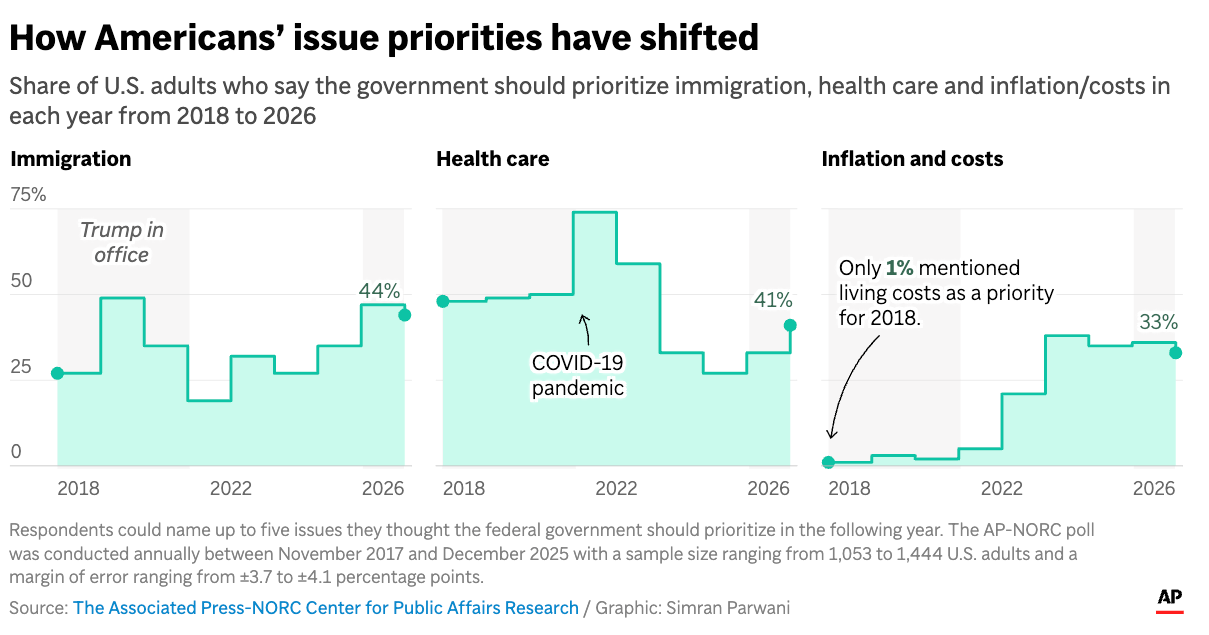
Healthcare is a faster growing issue priority cited by the American public than other issues. At the same time, immigration and cost of living remain highly salient (AP-NORC)
The wealthiest 1% are responsible for much less than 40% of all tax revenue. The oft-repeated claim made across the political spectrum conflates wealth with income, when in fact (1) highest net-worth individuals pay nominal income taxes and (2) estate taxes fails to truly ‘sweep up’ gains based on wealth transfers. The result is that the wealthiest 1% are “just as likely to be as part of the 40% who pay no federal income tax as they are the top 1% of earners who pay all the taxes” (Ray Madoff / The Second Estate / Capitalisn’t)
There is not a Gen Z religious revival happening in the US or UK and surveys that claim there are biased. A more accurate story is stabilization, rather than revival (Conrad Hackett / Pew, Ryan Burge, Ross Douthat / NYT)
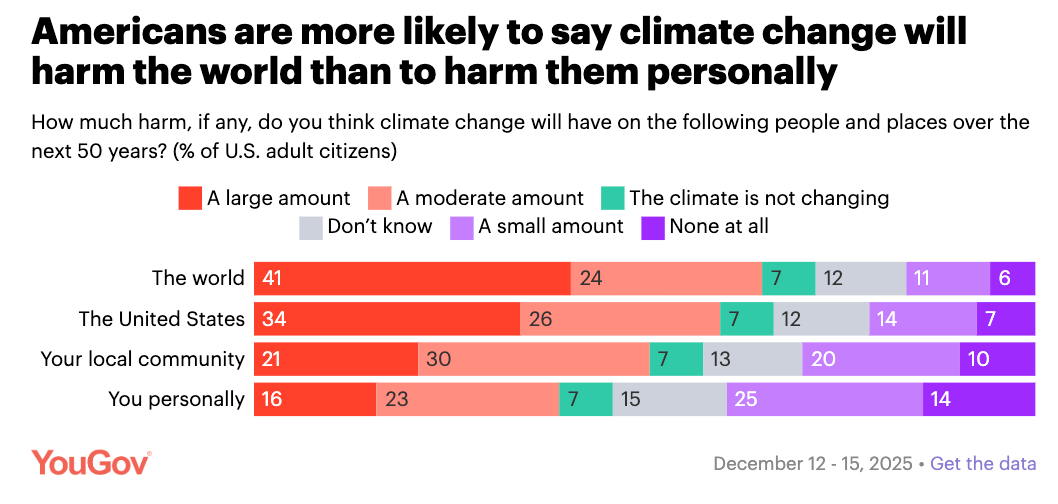
Americans are more likely to think climate change will be harmful to the world than to them personally. Notably, adults under 30 are more likely than older Americans to say climate change will do a large amount of personal harm to them in the next 50 years (Jamie Ballard / YouGov)
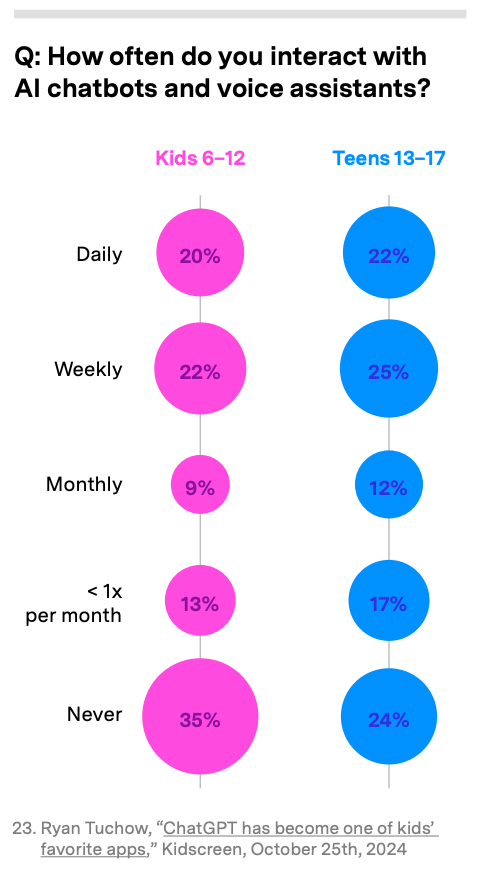
Almost half of teens (47%) and kids aged 6-12 (42%) say that they interact with AI assistants on at least a weekly basis. Before you shout to the clouds that Gen Alpha is also cooked, these self-reported exposure numbers are likely to be inflated. Still, the research design supporting this is just so cool (and an interesting usage of LLMs for research): researchers processed a digitized library of 7,241 stories written by children participating in a non-profit ‘story-telling’ program (National Research Group). Analyzing themes in their stories surfaced some other surprising discoveries:
~75% of male students depict technology positively vs. only ~20% of female students,
67% of kids and teens wrote that smartphones make the world better, compared to only 41% who depicted the same for AI
The U.S. in 2025 experienced the lowest population growth since the pandemic. A sizable reduction in net international migration was the main reason for the slowdown (U.S. Census Bureau)
Global geospatial estimates of rural populations have been underestimated by between 53-84% from 1975-2010. Human resettlement counts from large dam construction projects — granular, on-the-ground estimates independent from Census authorities and thought to be high quality by necessity — show that satellite-based and other geospatial estimates are off by a staggering amount (Popular Mechanic, Ritter et al / Nature Communications)
77% of American moms in an online poll admit to having a “hospital fantasy”. This is an old finding and we should take online non-probability samples with a gigantic grain of salt … but still, yeesh (Katrina Alcorn / Maxed Out: American Moms on the Brink)
The American public has the greatest stigmatizing attitudes toward methamphetamine use disorder relative to other substance disorders. This includes cocaine use disorder, opioid use disorder, and alcohol use disorder. This was particularly true for adults with ‘abstinence-only’ attitudes about addiction recovery (Meadows et al / Substance Use & Misuse, AmeriSpeak)
Dutch babies laugh, smile and cuddle more than American babies. Though the study can’t dissect the exact cultural reasons, Rina Mae Acosta in The Happiest Kids in the World writes that “childhood [in the Netherlands] consists of lots of freedom, plenty of play, and little academic stress. As a consequence Dutch kids are pleasant to be around” (European Journal of Developmental Psychology, Please Yell at My Kids / Marina Lopes)
On Moltbook (the “Reddit for AI agents” that sprung up this past week), ~94% of comments get zero replies and more than one-third of messages are duplicates. Across some 13,000 posts and 115,000 comments, the phrase “my human” appears in 9.4% of all messages (David Holtz / Rohit Krishnan)